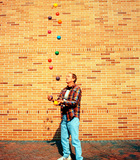
There’s more mathematics involved in juggling than just trying to make sure that the number of balls (or chainsaws) that hits the ground stays at zero. Subjects such as combinatorics and abstract algebra help jugglers answer important questions, such as whether a particular juggling pattern can actually be juggled. For example, can balls be juggled so that the time period that each ball stays aloft alternates between five counts and one? The answer is "Yes." Math also tells you that the number of balls needed for such a juggling pattern is the average of the counts, in this case three.
Once a pattern is shown to be "juggleable" and the number of balls needed is known, equations of motion determine the speed with which each ball must be thrown and the maximum height it will attain. Obviously the harder a juggler throws, the faster and higher an object will go. Unfortunately hang time increases proportionally to the square root of the height, so the difficulty of keeping many objects in the air increases very quickly. Both math and juggling have been around for millennia yet questions still remain in both subjects. As two juggling mathematicians wrote, "A juggler, like a mathematician, is never finished: there is always another great unsolved problem."1
1. "Fountains, Showers, and Cascades," Joe Buhler and Ron Graham. The Sciences, January-February 1984.



 There’s more mathematics involved in juggling than just trying to make sure that the number of balls (or chainsaws) that hits the ground stays at zero. Subjects such as combinatorics and abstract algebra help jugglers answer important questions, such as whether a particular juggling pattern can actually be juggled. For example, can balls be juggled so that the time period that each ball stays aloft alternates between five counts and one? The answer is "Yes." Math also tells you that the number of balls needed for such a juggling pattern is the average of the counts, in this case three.